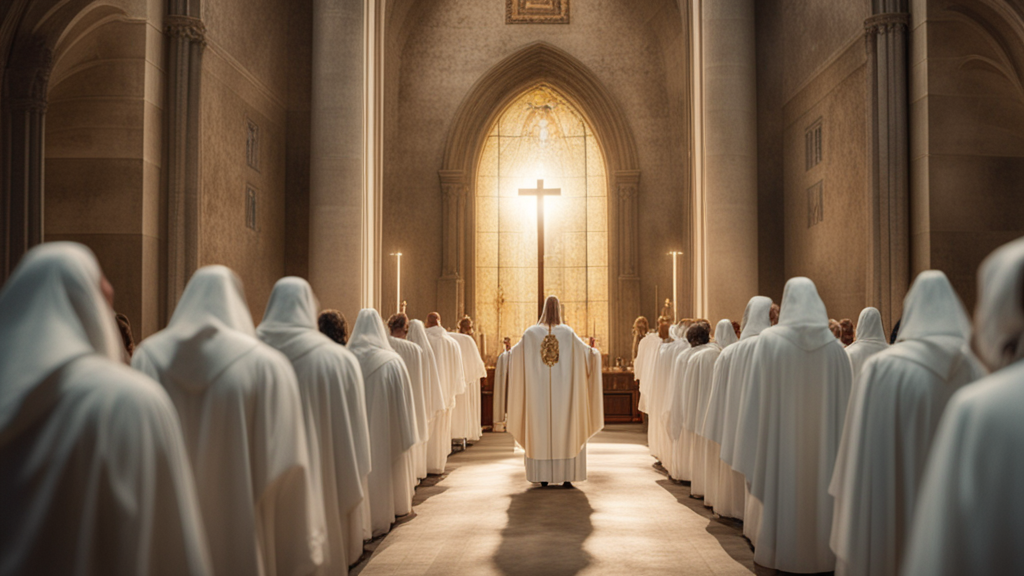
“Let Jesus Do the Heavy Lifting”: What the National Eucharistic Revival Gets Right—and What Your Soul Can’t Afford to Miss
The Hidden Spiritual Conflict
The headlines say it simply: “Let Jesus do the heavy lifting.” The National Eucharistic Revival has taken a hard look at the American Church and concluded that renewal won’t come by strategy alone. It must come from surrender. That lands like a thunderclap in an age of spiritual hustle: more content, more events, more outrage, more pressure to build your life—and your church—by sheer willpower.
We are tired. Pastors are quitting. Parents are barely holding on. College students are anxious. Politically, we’re tribal. Technologically, we’re addicted. Spiritually, many feel numb. We keep trying to carry what only God can bear: the weight of our salvation, our identity, our future, our families, and our fractured nation.
The Revival’s claim is not new—but it is urgent: Christ Himself must carry us. The Church has always proclaimed a Savior who does what we cannot do. But do we believe that in practice? Or are we secretly trusting our tactics, our news feeds, and our self-optimization to do the job only grace can do?
Here’s the spiritual conflict beneath the headlines: Will we live like functional atheists—praying with our lips while relying on our strength—or will we return to a living dependence on the Lord who said, “Apart from me you can do nothing” (John 15:5)?
This is not a Catholic problem or a Protestant problem—it’s a human problem. Whether you contemplate Christ’s presence at the Table, the power of His Word preached, or the Spirit’s ministry in the gathered church, the issue is the same: will Jesus be central, sufficient, and supreme (Colossians 1:18), or will He be a mascot for our exhausted programs?
What the Bible Really Says
The Bible is not ambiguous about who carries the weight.
“Come to me, all who labor and are heavy laden, and I will give you rest.” (Matthew 11:28)
Jesus does not invite the well-rested; He calls the weary. His promise is not a spiritual pep talk but a transfer of weight—His yoke for ours, His rest for our burdens (Matthew 11:29-30).
“Cast your burden on the Lord, and he will sustain you.” (Psalm 55:22)
Scripture assumes a people who constantly offload their anxiety onto God. Not once. Not occasionally. Continually.
“Cast all your anxieties on him, because he cares for you.” (1 Peter 5:7)
The Greek sense is ongoing action—keep casting. Why? Because God is not annoyed by your need; He is glorified when you trust His care (Hebrews 11:6).
“The Lord is my shepherd; I shall not want.” (Psalm 23:1)
Sheep do not carry. They are led. Provision, guidance, and protection are shepherd work. Our job is to follow.
“Unless the Lord builds the house, those who build it labor in vain.” (Psalm 127:1)
Ministry without dependence is motion without progress. The Bible does not celebrate frenetic activity; it commands abiding.
“Abide in me… apart from me you can do nothing.” (John 15:4-5)
Nothing eternal is produced by human steam. Fruit comes from union with Christ, not effort detached from the Vine.
“My grace is sufficient for you, for my power is made perfect in weakness.” (2 Corinthians 12:9)
Weakness is not the enemy of power in the Christian life; it is the doorway. Paul boasts in weakness because it is the place where Christ’s power rests.
“God opposes the proud but gives grace to the humble.” (James 4:6)
If we build ministries or personal brands on pride—on what we can engineer—we attract opposition from God Himself. Revival begins with humility, not hype.
“He is before all things, and in him all things hold together.” (Colossians 1:17)
That includes your church, your family, your mind, your timeline, your tomorrow. Christ doesn’t merely help; He holds.
“Do this in remembrance of me.” (Luke 22:19)
At the Table, Jesus commands us to remember—because we forget. Whether your tradition emphasizes the real presence of Christ, the spiritual presence by faith, or the memorial commanded by Christ, the center is the same: we don’t save ourselves. We receive. We remember. We return to the cross where the heaviest lifting was done once for all (Hebrews 10:10-14; 1 Peter 2:24).
“For I decided to know nothing among you except Jesus Christ and him crucified.” (1 Corinthians 2:2)
Paul’s strategy was not cleverness but the cross. That is the Revival’s deepest lesson: Jesus Himself is the method and the message.
Why This Matters in 2026
- Anxiety epidemic: We self-medicate with screens and schedules. Scripture offers a Person: “The Lord is at hand; do not be anxious” (Philippians 4:5-7). Prayer turns panic into peace.
- Political fracture: We demand Caesar-level solutions to heart-level problems. “Our citizenship is in heaven” (Philippians 3:20). That identity stabilizes us amidst elections and algorithms.
- AI acceleration: We chase machine efficiency and forget human limits. “It is in vain that you rise up early and go late to rest… for he gives to his beloved sleep” (Psalm 127:2). Rest is not laziness; it’s faith.
- Church burnout: Leaders confuse outputs for outcomes. Jesus rebuked frantic service disconnected from listening: “Mary has chosen the good portion” (Luke 10:41-42). Presence precedes productivity.
The Eucharist, the Table, and the Cross
However you name it in your tradition—the Eucharist, Communion, the Lord’s Supper—Scripture directs our gaze to Christ crucified and risen.
- It is remembrance and proclamation: “As often as you eat this bread and drink the cup, you proclaim the Lord’s death until he comes” (1 Corinthians 11:26).
- It is participation by faith: “The bread that we break, is it not a participation in the body of Christ?” (1 Corinthians 10:16).
- It is examination and repentance: “Let a person examine himself” (1 Corinthians 11:28).
The Revival’s headline—let Jesus do the heavy lifting—harmonizes with the Table’s sermon: You receive what you cannot earn, you proclaim what you cannot improve, and you rest in what Christ has finished (John 19:30).
3 Steps for Believers Today
1) Trade Your Yoke: Practice Daily Transfer
You carry more than you realize—notifications, expectations, secret fears. Each morning, enact a “transfer of weight.”
- Pray Psalm 55:22 aloud: “I cast my burden upon You.” Name the specific burdens: the meeting, the diagnosis, the child, the temptation.
- Read Matthew 11:28-30 slowly. Picture setting down your load and taking Christ’s yoke—His teaching, His pace, His heart. His yoke is kind; His burden is light.
- Journal one sentence: “Jesus, You lift what I cannot.” Sign and date it. This is your daily contract of dependence.
Why? Because Scripture commands continual casting (1 Peter 5:7) and constant abiding (John 15:4). You cannot abide accidentally. You choose to transfer.
2) Re-center Worship: Make Jesus the Method, Not a Mascot
Churches and families can drift into program-centric spirituality. Resist that drift.
- Rebuild around Scripture and prayer (Acts 2:42). Keep the Word central on Sundays and in homes. Open the Bible and let God speak.
- Approach the Table (or Communion in your tradition) with repentance and faith (1 Corinthians 11:28-29). Before you eat, lay down your pride, confess your sin (1 John 1:9), and receive grace like the starving.
- Measure ministry by fruit of the Spirit (Galatians 5:22-23), not platform metrics. Are people becoming gentle, patient, self-controlled, Christ-like? That is the evidence Jesus is lifting.
- Leaders: Imitate Paul’s weakness-shaped ministry (2 Corinthians 12:9-10). Share stories of dependence. Normalize rest. Honor sabbath (Mark 2:27). Plan less hype, more hunger for God.
The Revival’s report is right: renewal isn’t manufactured. It’s received. If Christ is truly present and active among His people (Matthew 28:20), our main job is to draw near in faith (Hebrews 10:22) and obey.
3) Live the Posture of Humble Boldness
Letting Jesus carry you doesn’t make you passive; it makes you courageous.
- Pray before panic (Philippians 4:6-7). When the news cycle spikes, drop to your knees before you refresh the feed.
- Obey the next clear step (James 1:22). Dependence is not dithering. When the Word speaks, move.
- Speak the gospel plainly (Romans 1:16; 1 Corinthians 2:1-5). Don’t dress the cross in modern polish. Announce that Jesus saves sinners by His blood (Ephesians 1:7).
- Practice tangible love (John 13:34-35). Carry someone else’s groceries. Sit with the grieving. Forgive quickly (Ephesians 4:32). The world recognizes a people who have been carried by grace because they become burden-bearers for others (Galatians 6:2).
Humble boldness looks like this: head bowed in prayer, hands open in service, voice steady in truth. That posture is revival-ready.
A Prayer for Letting Jesus Do the Heavy Lifting
Father, we confess we have tried to build what only You can build (Psalm 127:1). We have carried anxieties You never asked us to hold (1 Peter 5:7). We have trusted methods more than the Master. Forgive us through the blood of Jesus (1 John 1:9; Ephesians 1:7).
Lord Jesus, You are the Good Shepherd (John 10:11). We come to You weary and heavy laden. We take Your yoke and learn from You, for You are gentle and lowly in heart (Matthew 11:28-29). Lift what we cannot lift: our sins, our shame, our families, our churches, our nation. Be the center at Your Table, the life in our worship, the Vine in which we abide (John 15:5).
Holy Spirit, teach us to cast, to abide, to obey. Produce in us love, joy, peace, patience, kindness, goodness, faithfulness, gentleness, and self-control (Galatians 5:22-23). Make weakness our doorway to power (2 Corinthians 12:9). Unite Your Church around Christ and Him crucified (1 Corinthians 2:2). Let the watching world see not our strength but Your glory (2 Corinthians 4:7).
We surrender our outcomes, our timelines, and our reputations. Jesus, do the heavy lifting. We will walk by faith (2 Corinthians 5:7). Amen.
If this spoke to you, take one action today: write down three burdens and, in prayer, hand them to Jesus by name. Then text one friend: “I’m letting Jesus do the heavy lifting. Will you join me?” Let revival begin where it always does—in surrendered hearts anchored to Scripture and centered on Christ.
Did this resonate nicely?